


The Price of Passion Fruit in Colombia for Export: What an Importer Pays and What Determines It
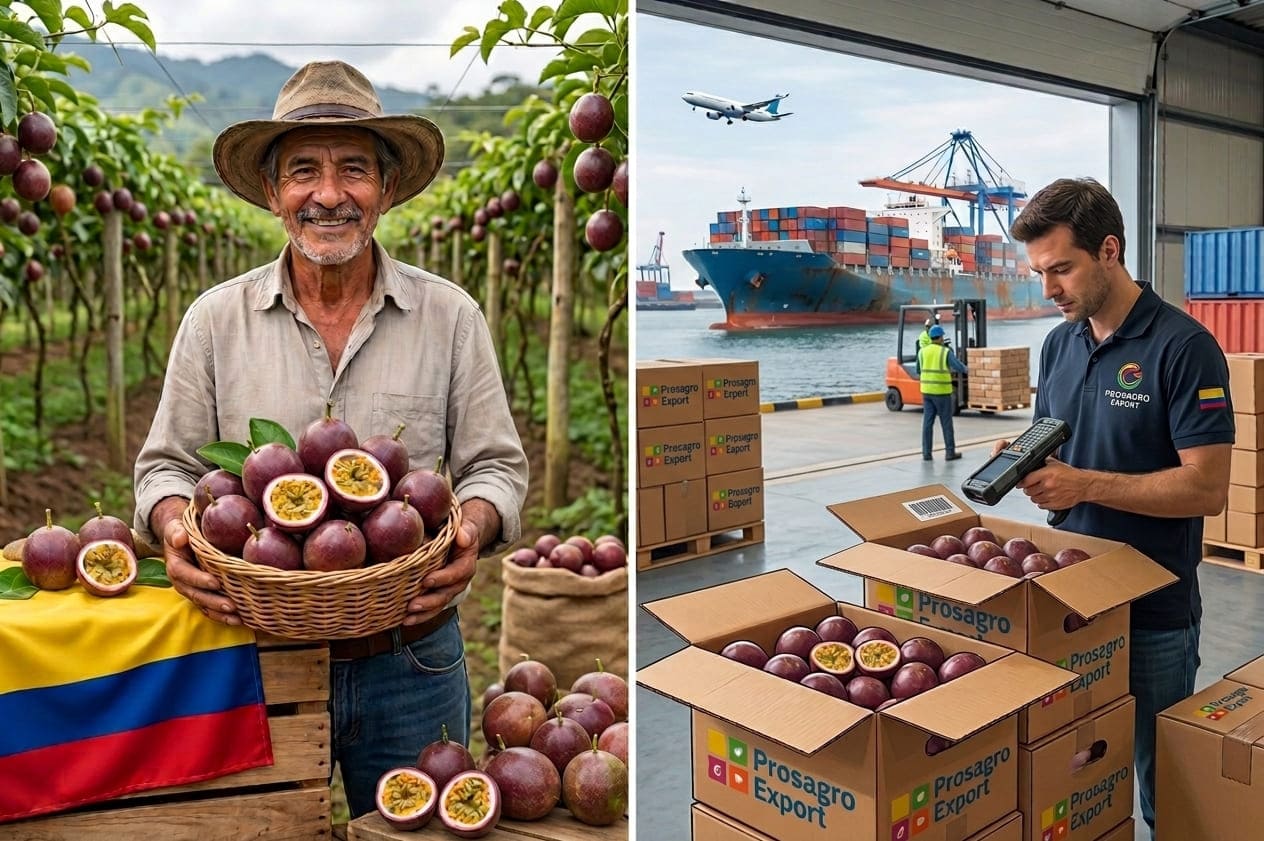
If you import exotic fruit and are considering buying passion fruit in Colombia, the first question is usually how much it costs. The honest answer is that export passion fruit has no single list price: the value is quoted according to volume, quality, the Incoterm, the destination and the time of year. What we can do is show you the public figures that serve as a reference and explain what makes up the price you will pay, so that you can compare offers on an informed basis.
How much Colombian export passion fruit is worth
The most objective way to look at the export price is to divide the exported value by the volume. Using the DIAN figures published by Analdex for fresh passion fruit, the result is as follows:
| Year | Exported value (USD FOB) | Volume | Average value per kilo |
| 2023 | USD 47.8 million | 14,266 tonnes | USD 3.35 FOB |
| 2024 | USD 52.2 million | 13,320 tonnes | USD 3.92 FOB |
| 2025 | +24% vs 2024 | −3% vs 2024 | Around USD 5.00 FOB (estimated) |
Source: Analdex with DIAN data (2023 and 2024); DANE, cited by Bancolombia (2025 variation). The average value per kilo is our own calculation based on the exported value and volume. The 2025 figure is an estimate that applies the DANE variations to the 2024 base, because at the time of writing the annual breakdown in dollars and tonnes had not yet been published.
In 2024, Colombia exported fewer tonnes than in 2023, but for more money: the average value rose by around 17%, to roughly USD 3.92 per kilo FOB. In 2025 the same thing happened, even more markedly. Passion Fruit exports grew by 24% in dollars while volume fell by 3%, according to DANE. That means each exported kilo was worth, on average, around 28% more than in 2024 — approximately USD 5 FOB.
In 2026 the value continues to grow:
| Period | Exported value (USD FOB) | Change |
| January to August 2025 | USD 40.2 million | — |
| January to August 2026 | USD 45.5 million | +13.3% |
Source: Analdex with DIAN data, published in October 2026. The 2026 volume has not yet been published, so it is not yet possible to calculate this year’s value per kilo.
That average serves as a general reference, not as a quotation. Behind it lies fruit of different sizes, long-term contracts and one-off sales, with FOB and CIF negotiations all mixed together. The price of a specific order may be higher or lower.
Why the local price is not the export price
When searching for the price of passion fruit in Colombia, it is easy to find the one reported by DANE’s SIPSA for Corabastos, the main wholesale market in Bogotá. In October 2026 it was around COP 3,158 per kilo.
That figure is not comparable with the export price. It is fruit for the domestic market, much of which does not meet the size, colour or sanitary standards required by a European importer. It also does not include grading, packing, certifications, cold chain or freight. If a supplier offers you export passion fruit at the local market price, it is worth asking which part of that chain they are leaving out.
What makes up the price of export passion fruit
The price an importer pays is built up in several layers. Understanding them helps you make sense of a quotation and see where the difference lies between two suppliers.
1. The fruit at the farm
This is the starting point: what the exporter pays the grower for fruit that meets the export standard. That price moves with the harvest and with the international market. At Prosagro we pay it transparently and linked to the real market, because a grower who receives a fair price is a supplier who keeps delivering season after season.
2. Grading, classification and packing
Passion Fruit is selected by size, colour and sanitary condition, and packed to the client’s specification: weight per box, size, labelling and brand. The more demanding the specification, the more fruit is left out of the selection and the more each approved box costs.
3. Certifications and compliance
Fruit for Europe must meet the phytosanitary requirements of the ICA and, depending on the buyer, standards such as GLOBALG.A.P., GRASP or SMETA. Maintaining those certifications carries an auditing and management cost on each farm. In return, the importer receives traceability and the assurance that the fruit will pass the controls at destination.
4. Cold chain and freight
Passion fruit is perishable and travels mainly by air to Europe. Freight is one of the items that weighs most heavily on the final price, and it changes with the season and the availability of cargo space. This is why the Incoterm matters: an FCA or FOB quotation leaves freight to the buyer’s account, whereas a CPT or CIF quotation includes it up to the destination airport.
5. The exchange rate
Costs in Colombia are paid in pesos and the sale is made in dollars or euros. When the peso strengthens, each local cost becomes more expensive in dollars. And in recent months the peso has strengthened considerably. This is the monthly average of the TRM, the market representative exchange rate certified by the Financial Superintendence:
| Month | Average TRM (pesos per dollar) |
| January 2025 | COP 4,292 |
| June 2025 | COP 4,114 |
| October 2025 | COP 3,881 |
| January 2026 | COP 3,693 |
| May 2026 | COP 3,719 |
| June 2026 | COP 3,497 |
| July 2026 | COP 3,272 |
| August 2026 | COP 3,127 |
| September 2026 | COP 3,184 |
| October 2026 (to the 24th) | COP 3,209 |
Source: TRM certified by the Financial Superintendence of Colombia, published on datos.gov.co. Monthly averages calculated from the daily TRM.
The sharpest fall came between May and August 2026, when the TRM dropped by around 16%. The lowest point was COP 3,048 on 22 August. Over the past year, the TRM moved from COP 3,889 on 24 October 2025 to COP 3,158 on 24 October 2026, a fall of almost 19%.
For the importer, the effect is direct. A cost of COP 10,000 in Colombia — such as labour, packing or transport to the airport — was equivalent to about USD 2.57 a year ago and today equals about USD 3.17: 23% more in dollars without anything having changed at the farm. This is why a quotation in dollars can rise even if the price of the fruit in pesos stays the same, and why it is worth agreeing with your supplier how often the price is reviewed and against which reference rate.
6. The season and the weather
In Colombia, passion fruit is produced all year round, with harvest peaks. During those peaks there is more fruit available and the price tends to ease. Heavy rains or an El Niño event can reduce supply months later. A supplier with agronomic management prepared for El Niño reduces the risk of your contracted volume falling short.
What the market you are buying from looks like
Colombia is one of the world’s leading producers and exporters of passion fruit, and passion fruit is the fruit that leads its exotic-fruit exports. Between January and August 2026 it accounted for 92.8% of the exported value in that category, according to Analdex. Within that same group of exotic fruits, the Netherlands was the main destination, with 75.6% of the value, followed by the United Kingdom, Germany and Canada. Cundinamarca and Antioquia account for most of the exportable supply.
For a buyer, this means two things. There is consolidated supply and export experience. And competition for the best-quality fruit also exists, so securing volume in advance is easier than finding it on the spot market. If you want the full context.
What to ask before requesting a quotation
To compare offers of Colombian passion fruit on equal terms, it helps to have each supplier answer the same points:
- Incoterm and delivery point: FCA or FOB at a Colombian airport, or CPT/CIF at your destination airport.
- Specification: size, colour, weight per box and labelling.
- Current certifications of the farms and the packing facility, with supporting documentation.
- Volume and frequency they can guarantee, including in the low season.
- Traceability: whether they can identify the farm of origin of each batch.
- Payment terms and the currency of the quotation.
A low price without clear answers to these questions often turns out expensive at destination, with rejections, out-of-specification fruit or volumes that fail to arrive.
Frequently asked questions from importers
How much does a kilo of Colombian export passion fruit cost?
There is no list price. As a reference, the average export value of Colombian passion fruit was around USD 3.92 per kilo FOB in 2024, according to DIAN data published by Analdex, and in 2025 it is estimated at close to USD 5 per kilo FOB based on the variations reported by DANE. Each quotation depends on volume, specification, Incoterm and season.
Can passion fruit be bought all year round?
Yes. In Colombia it is produced all year round, with harvest peaks when availability increases. A purchase programme with agreed volumes also secures fruit for you during the lower-supply months.
What does passion fruit need to enter the European Union?
It must meet the ICA’s phytosanitary requirements and the EU rules on residues and plant health, and in most cases hold certifications such as GLOBALG.A.P. The detail is in our article on how to export passion fruit from Colombia.
Why is the price of passion fruit in Colombia so different from the export price?
Because the local price corresponds to fruit for the domestic market, without export grading, certifications, packing or freight. The export price includes that entire chain.
If you are an importer or distributor and would like a quotation for Colombian passion fruit based on your volume, specification and destination, get in touch. We will reply with a clear price and explain what it includes.
