


How to import gulupa from Colombia to Europe: requirements, certifications and transport
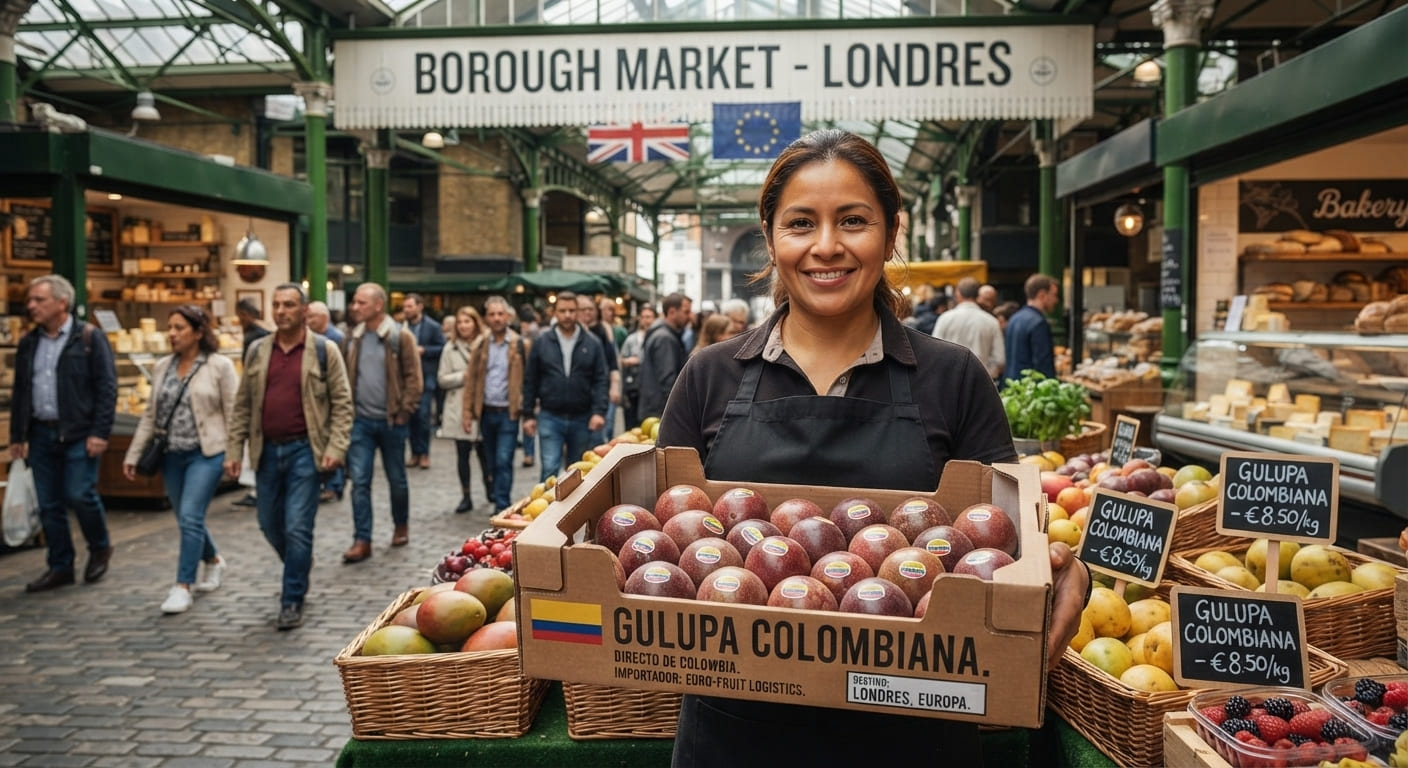
If you import exotic fruit and want to bring Colombian gulupa (purple passion fruit) into Europe, the price is rarely the hardest part of the decision. The real question is whether the fruit will clear the border without being held. To enter the European Union, gulupa needs a phytosanitary certificate issued by the ICA, must comply with EU maximum residue levels for pesticides, and must pass checks at a border control post, where 20% of Colombian gulupa and granadilla consignments are currently inspected. Certifications such as GLOBALG.A.P. are not required by law, but most buyers ask for them. And the fruit usually travels by air, because its post-harvest life is short.
This guide explains each requirement, the documents you should ask your supplier for, and what changes if your destination is the United Kingdom.
Phytosanitary requirements: the ICA certificate
The EU regulates the entry of plants and plant products through Implementing Regulation (EU) 2019/2072. Fruits of Passiflora, the genus gulupa belongs to, are on the list of products that need a phytosanitary certificate to enter the Union. Only five fruits are exempt: pineapple, coconut, durian, banana and dates (European Commission).
In Colombia, the certificate is issued by the Colombian Agricultural Institute (ICA) after the lot has been inspected. Three conditions must be met first:
- Registered farm: the farm of origin must be registered with the ICA as a site producing fresh plant products for export.
- Registered exporter and packhouse: the exporter and the packhouse where the fruit is graded and packed must also be registered with the ICA.
- Fruit free from EU quarantine pests: the inspection checks that the lot meets the destination’s requirements, including any additional declarations required by EU rules.
The certificate travels with every consignment. Without it, the cargo cannot enter the European Union.
Pesticide residues: the point the EU checks most
Maximum residue levels (MRLs) are set by Regulation (EC) No 396/2005. Gulupa falls under the “passion fruits/maracujas” category (code 0162030) in the EU Pesticides Database, where you can look up the limit for each active substance. When a substance is not approved in the EU, its limit is usually set at the lowest level a laboratory can detect. This is why a product that is permitted in Colombia can still lead to a rejection in Europe.
This matters even more for Colombian fruit. The EU lists Colombian granadilla and passion fruit (Passiflora ligularis and Passiflora edulis, the species gulupa belongs to) among the products subject to increased official controls for pesticide residues. The frequency of identity and physical checks rose to 20% of consignments in 2025, and Implementing Regulation (EU) 2026/1206, in force since 30 June 2026, keeps it at that level.
In practice, one in five consignments may be held at the border until the laboratory results are in. If a sample exceeds a limit, the lot is rejected or destroyed and the case is notified in the RASFF alert system. That track record is what drives the control frequency up for the whole country.
So it makes sense to ask your supplier for:
- The crop protection plan for the farms, with the products used and their pre-harvest intervals.
- Recent residue analyses from an accredited laboratory, compared against EU MRLs.
- Traceability from every box back to the farm of origin.
Arrival in Europe: the border control post
Each consignment must be pre-notified in the EU’s TRACES system with a Common Health Entry Document (CHED). It then enters through a border control post, where the authorities carry out three types of checks:
- Documentary: they review the phytosanitary certificate and the other shipping documents.
- Identity: they confirm that the cargo matches what was declared.
- Physical: they inspect the fruit and, when the consignment is selected, take samples for residue analysis.
The importer or their customs agent usually files the TRACES notification. This is why the exporter needs to send the documents before the cargo leaves Colombia.
Certifications European buyers ask for
EU law does not require private certifications, but the market does. Supermarkets and distributors in Germany, the Netherlands, the United Kingdom and France usually ask for:
- GLOBALG.A.P.: good agricultural practices on the farm, including crop protection and traceability.
- GRASP: the social add-on to GLOBALG.A.P. It assesses working conditions on the farm.
- SMETA: an ethical audit that many retailers use to verify labour rights, health and safety, environment and business ethics in their supply chain.
- BRCGS or IFS: some customers require one of these at the packhouse.
At Prosagro Export we hold current ICA, GLOBALG.A.P., GRASP and SMETA certifications. You can read more about why buyers value them in our article on why international buyers prefer gulupa.
Air or sea freight
Gulupa is perishable and needs an unbroken cold chain from post-harvest to destination. In export chains it is usually kept refrigerated at around 7 °C (Agronomía Colombiana, 2024), and very low temperatures can cause chilling injury. Transit time therefore decides which mode makes sense.
| Air | Sea (reefer container) | |
|---|---|---|
| Transit time | One to three days to the European airport | Two weeks or more, depending on port and route |
| Freight cost | High; varies with the season and available cargo space | Lower per kilo |
| Shelf life on arrival | Most of the fruit’s commercial life is left for sale | The voyage uses up a large share of shelf life |
| Volume | Works with small, frequent shipments | Requires a full container |
| When it makes sense | The usual option for fresh gulupa to Europe | Only for planned programmes, with fruit at the right maturity and no breaks in the cold chain |
This is why gulupa travels to Europe mainly by air. From Antioquia, cargo leaves through José María Córdova airport (Rionegro) or El Dorado (Bogotá). For sea freight there is a new option in the region: in April 2026 the first containers of Hass avocado and flowers left Puerto Antioquia, on the Urabá coast, bound for France and England (El Colombiano).
The Incoterm matters too. An FCA or FOB quotation leaves freight to the buyer, while a CPT or CIF quotation includes it up to the destination airport or port. We explain how this affects the final price in our article on the export price of gulupa from Colombia.
Documents every consignment needs
| Document | Issued by | Purpose |
|---|---|---|
| Phytosanitary certificate | ICA | Mandatory to enter the EU |
| Commercial invoice and packing list | Exporter | Customs and cargo control |
| Proof of origin | Exporter | Claiming tariff preferences under the EU–Colombia trade agreement |
| Air waybill (AWB) or bill of lading (B/L) | Airline or shipping line | Contract of carriage |
| Export declaration (DEX) | Exporter, filed with the DIAN | Legal exit from Colombia |
| Residue analyses and GLOBALG.A.P., GRASP and SMETA certificates | Laboratory and certification bodies | Commercial requirement of the buyer |
The full process on the Colombian side is covered in our guide on how to export gulupa from Colombia.
What if the destination is the United Kingdom?
Since Brexit, the UK applies its own rules. For Great Britain, fruits of Passiflora are on the list of products that do not need a phytosanitary certificate (legislation.gov.uk). However, Colombian passion fruit and granadilla are also subject to increased checks for pesticide residues there, at 10% of consignments under the list in force in England for 2026. Pre-notification is made in the UK’s IPAFFS system. As these rules change often, always confirm the current requirements with your customs agent before the first shipment.
Frequently asked questions
Does gulupa need a phytosanitary certificate to enter Europe?
Yes. For the European Union, fruits of Passiflora require a phytosanitary certificate, which in Colombia is issued by the ICA. The United Kingdom, on the other hand, exempts them from that certificate.
Why are some Colombian gulupa consignments held at the border?
Because the EU applies increased controls for pesticide residues to Colombian granadilla and passion fruit, at a frequency of 20% of consignments. Selected cargo waits at the border control post until the laboratory results are in.
Can gulupa be shipped to Europe by sea?
It is possible in a reefer container, but a transit of two weeks or more uses up a large share of the fruit’s shelf life. That is why most fresh gulupa travels by air.
What certifications should a gulupa supplier have?
The ICA phytosanitary certificate is mandatory. On top of that, most European buyers ask for GLOBALG.A.P., and many also ask for GRASP and SMETA.
Import gulupa from a supplier that complies at origin
At Prosagro Export we grow and export gulupa from eastern and south-western Antioquia, with current ICA, GLOBALG.A.P., GRASP and SMETA certifications and traceability back to the farm. If you are looking for a supplier for Europe, get in touch. We will send you the shipping documentation and a quotation based on your volume and destination. We are also open to exporting to new countries.
