


How to export gulupa from Colombia: Process, requirements and destination markets
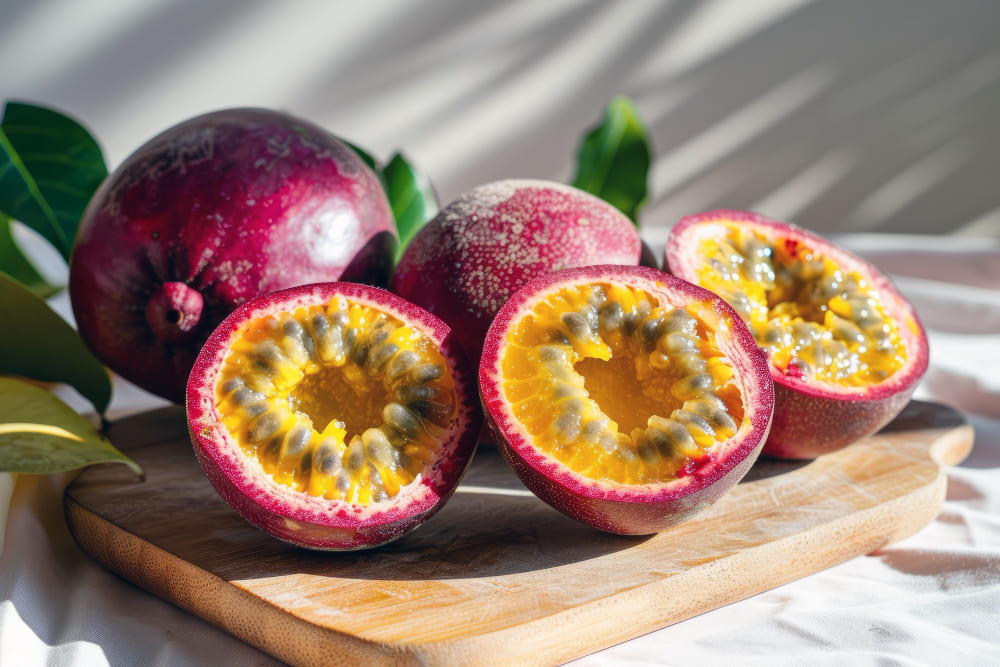
Colombia is the world's leading producer of passion fruit (Passiflora edulis f. edulis), and its fruit reaches markets across Europe, North America and Asia on a regular basis.
Aquí encontrarás...
But between the farm and a European supermarket lies a chain of paperwork, certifications and logistical decisions that are not always obvious to the grower or exporter. Here we walk you through all of it.
Why does Colombia dominate the global passion fruit market?
Colombian passion fruit is grown mainly in the departments of Cundinamarca, Antioquia, Huila, Boyacá and Nariño, at altitudes ranging between 1,800 and 2,200 meters above sea level. These conditions of high elevation and stable temperatures produce a fruit with an acidity-sweetness balance that is difficult to replicate at other latitudes.
Unlike yellow passion fruit (Passiflora edulis f. flavicarpa), purple passion fruit has a dark purple skin, a more aromatic pulp and a sensory profile that European buyers recognize as a differentiated product.
This unique trait, combined with the climatic stability of the Colombian Andes, drives steady growth in international demand.
According to ProColombia, the country's official export promotion agency, tropical exotic fruits are one of the sectors with the greatest growth potential for Colombia, and passion fruit leads the group of exported passifloras.
Main importing markets for Colombian passion fruit
The largest volume of passion fruit exports from Colombia is destined for Europe.
The Netherlands, with the Port of Rotterdam as the main point of entry, acts as a distribution hub for the rest of the continent. From there, the fruit is redistributed to Germany, France, the United Kingdom, Spain and Belgium, among others.
North America — especially Canada — is another growing destination, driven by Latin American communities and by the interest of chefs and bartenders in exotic ingredients. Japan and some Middle Eastern markets have also recorded imports of frozen Colombian passion fruit pulp.
Region | Main markets | Most demanded format |
|---|---|---|
Europe | Netherlands, Germany, France, UK, Spain | Fresh fruit + frozen pulp |
North America | Canada (niche markets) | Frozen pulp, fresh fruit |
Asia | Japan, South Korea | Frozen pulp, derivative products |
Phytosanitary requirements for exporting passion fruit
The Colombian Agricultural Institute (ICA) is the body responsible for certifying that exported fruit meets the phytosanitary conditions required by importing countries.
To export passion fruit legally from Colombia, growers and exporters must keep the following requirements in mind:
- Register the farm with ICA as a Productive Unit under Good Agricultural Practices (GAP).
- Obtain the ICA Phytosanitary Certificate for each export lot. This document certifies that the fruit is free of quarantine pests and diseases.
- Ensure that packaging and packing materials comply with the ISPM 15 standards of the International Plant Protection Convention (IPPC).
- Verify the specific requirements of the destination country, which may include additional restrictions on agrochemical residues.
Important: Phytosanitary requirements vary by destination country. The European Union, for example, requires compliance with the established maximum pesticide residue limits.
If you already have your passion fruit crop, before exporting, check the specific requirements of your target market with ICA and your customs broker.
Registration as an exporter with the DIAN
In addition to phytosanitary requirements, every Colombian exporter must be registered as such in the Single Tax Registry (RUT) with the DIAN, under the economic activity corresponding to foreign trade.
The formal export process includes filing the Export Declaration (DEX) with the DIAN and the authorized customs agency.
Beyond the RUT and its corresponding activity, an exporter registry for fresh fruit must also be obtained with ICA.
Certifications that European buyers require
Holding the ICA phytosanitary certificate is the minimum condition, but major distributors and European supermarket chains require additional standards:
- GlobalG.A.P.: The most internationally recognized Good Agricultural Practices certification. Required by most supermarkets in Germany, the Netherlands and the United Kingdom.
- HACCP (Hazard Analysis and Critical Control Points): A risk analysis and critical control point system, required in processing and packing facilities.
- BRC or IFS: Food safety standards required by some distributors in Northern Europe.
- Organic certification (optional): Generates premium prices in niche markets, especially in Germany, Austria and Switzerland.
Step-by-step export process
A successful passion fruit export involves coordinating several stages simultaneously:

- Harvesting and grading: Selection by size, color and Brix level (sugar content). Export fruit is usually graded as “Extra” or Category I.
- Cold chain: Immediate post-harvest pre-cooling to 8–10°C, maintained during inland transport to the port and throughout the international shipment.
- Packing: Boxes with labeling that must include country of origin, variety, net weight and exporter details.
- ICA phytosanitary certificate: Requested at least 24 hours before shipment.
- Dispatch and documentation: Export Declaration (DEX) + commercial invoice + packing list + bill of lading (B/L or airway bill, depending on the mode of transport).
How does Prosagro Export work with its growers?
One of Prosagro Export's differentiators is its allied-growers model: certified agronomists advise on planting, spraying and harvesting for farmers in key producing areas who work under the quality and GAP standards required for export. This technical support makes it possible to deliver fruit with higher quality standards.
This support and close work with growers has guaranteed full traceability from the farm to the international buyer — an increasingly common requirement among European importers, who must answer to their own consumers about the origin of the products they sell.
If you are a grower or importer interested in learning about our offering, you can contact us directly to start a conversation about volumes and terms.
Frequently asked questions about passion fruit exports
Can any grower export passion fruit directly?
Technically yes, as long as they have the production capacity needed for export, hold the ICA registration and meet the requirements set by the DIAN.
In practice, most small and medium-sized growers choose to sell through export companies such as Prosagro Export, which already have foreign commercial partners, cold-chain logistics and active international certifications.
How long does it take to ship passion fruit from Colombia to Europe?
By sea, transport from Colombian ports (mainly Buenaventura or Cartagena) to the Port of Rotterdam takes approximately 18–22 days in a refrigerated container. By air, the time is reduced to 2–3 days, but the costs are significantly higher and are usually reserved for urgent or smaller-volume shipments.
What documents does the importer need at the destination?
The importer must present to the customs authorities of the destination country: the ICA Phytosanitary Certificate (apostilled if necessary), the commercial invoice, the packing list and the bill of lading. In the European Union, a food import declaration may additionally be required depending on the product and the country of origin.
If you have any further questions, feel free to ask us about exporting or importing high-quality passion fruit.

